

But sand riding also puts your ebike under significantly higher stress than normal roads.
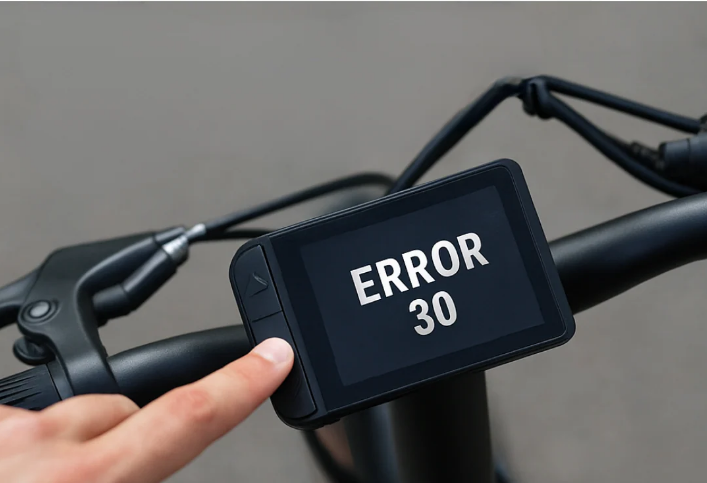
If your ebike suddenly stops working, shows an error code, or loses power after riding on sand, don’t panic—most issues are caused by protective system triggers rather than permanent damage.
In this guide, we’ll break down what’s happening and how to fix it step by step.
Why Sand Riding Is Hard on Ebikes
Compared to pavement, sand creates much higher resistance, which directly affects your system.
When riding on sand:
- The motor works harder to maintain speed
- Battery drains significantly faster
- Controller temperature rises more quickly
- Wheel traction becomes unstable in loose sand
Even fat-tire ebikes can struggle in deep or dry sand, especially under load or uphill riding.
Common Ebike Problems After Riding on Sand
After a beach ride, riders often report:
- Ebike not turning on
- Sudden power cut while riding
- Reduced motor power or weak acceleration
- Display showing an error code
- Pedal assist not responding properly
In many cases, the bike is not “broken”—it has entered a protection mode.
Why Sand Can Trigger Ebike Error Codes
Sand is fine and invasive. It can affect both mechanical and electrical systems.
1. Connector Contamination
Sand can enter:
- Battery terminals
- Motor connectors
- Sensor plugs
Even a small amount can interrupt communication signals.
2. Overload Protection (Overcurrent Shutdown)
When riding in deep sand:
- Motor draws higher current
- Controller may trigger safety shutdown
- System temporarily cuts power
This is a protective feature, not a failure.
3. Sensor Interference
Sand buildup near:
- Torque sensor
- Cadence sensor
- Pedal assist system
Can lead to:
- Delayed assist
- Inconsistent power delivery
- Error code activation
What to Do If Your Ebike Won’t Start After Sand Riding
Before assuming there is serious damage, follow these steps:
Step 1: Power Reset the System
- Turn off the bike completely
- Wait 2–5 minutes
- Restart the system
This clears temporary protection states.
Step 2: Check the Battery Connection
- Remove and reinsert the battery
- Ensure it is fully locked in place
- Check for sand or debris on contacts
A slightly loose battery can fully cut power.
Step 3: Inspect External Connectors
Look for sand buildup around:
- Display cable
- Motor cable
- Battery port
If needed, gently clean and reconnect.
Step 4: Let the System Cool Down
If you were riding hard in sand:
- The controller or motor may be overheated
- Let the bike rest for 15–30 minutes
Then restart again.
Step 5: Check for Error Codes
If an error code appears, it is your bike telling you:
- Where the issue is
- Which system triggered protection
Do not ignore the code—it helps narrow down the cause.
Preventing Sand-Related Ebike Issues
If you plan to ride on sand regularly, follow these precautions:
Regular Cleaning After Beach Rides
- Wipe down connectors
- Remove sand around motor and pedals
- Avoid high-pressure water directly on electronics
Avoid Deep Loose Sand When Possible
- Stick to wet or compact sand near shoreline
- Reduce load on steep or soft areas
Manage Motor Load
- Use lower assist levels
- Avoid full throttle in deep sand
- Let motor cool during long rides
Protect Electrical Connections
- Periodically check plugs and seals
- Ensure connectors are fully seated
When You Should Seek Professional Help
Contact support if:
- Error code persists after cleaning and reset
- Motor makes unusual noise
- Bike still has no power after battery check
- Assist system fails completely
These may indicate a deeper controller or sensor issue.
Further reading:
• How to Fix Error 30 on Your Ebike
• How to fix error code 24 (error 4) on electric bike
• How to Identify and Report Issues Efficiently
• What is error 25/ error 5 mean? How to fix error code 25 on electric bike
Riding an ebike on sand is fun, but it pushes your system closer to its limits.
The good news is:
Most post-sand riding issues are caused by:
- Temporary overload protection
- Loose or dirty connectors
- Sensor signal interruption
Not permanent damage.
With proper checks and basic maintenance, your ebike can return to normal quickly—and keep delivering smooth rides on and off the beach.
共有:
Fat Tire Ebikes for Sand Riding
Top 5 Electric Bike Accessories You Need in 2026